Please Note: Transcript partly generated by artificial intelligence and may contain inaccuracies.
Jeff Emtman 0:06
From KCRW, this is Here Be Monsters. Please note that this episode contains a vivid description of an assault.
Jacob Lemanski 0:17
It's dead Jeff. My ant has died. It’s been trapped in this cavern for maybe three days. Iwent home after it got dark. I left the ant pacing and they came back this morning and it was dead. It's curled up and it hasn't moved in hours.
Jeff Emtman 0:49
My friend Jacob Lemanski called me a few months ago. He wanted some advice on the problem he was having. I didn't help him out with it though. I figured he'd get better results if he just worked through it himself. So I told him to get off the phone with me and to just start recording his thoughts as they came to him.
Jacob Lemanski 1:10
I built this ant farm like six years ago. As an adult, you know, I was like 26 or 27 when I made this thing. I built it myself out of two pieces of plexiglass I got from work. The two plates of glass are about a quarter inch apart and the whole thing is maybe three feet wide and maybe 20 inches tall. I have it in a deep black frame and behind the and former LEDs that shine through. Then there's a blue matting in the back so it looks like sky. These ants that are in here right now I gathered them up just a couple of weeks ago from a giant ant hill south of town. I gathered the ants and I gathered dirt just from right there with the ants and I put them all in here and leaned it up against the wall and watch them dig in. Like there's no planning, they just they just dig and then they're making tunnels all over the place.
I think people don't realize about ant farms is that it changes constantly. You know, I hav it in a picture frame. It's it's a work of art.
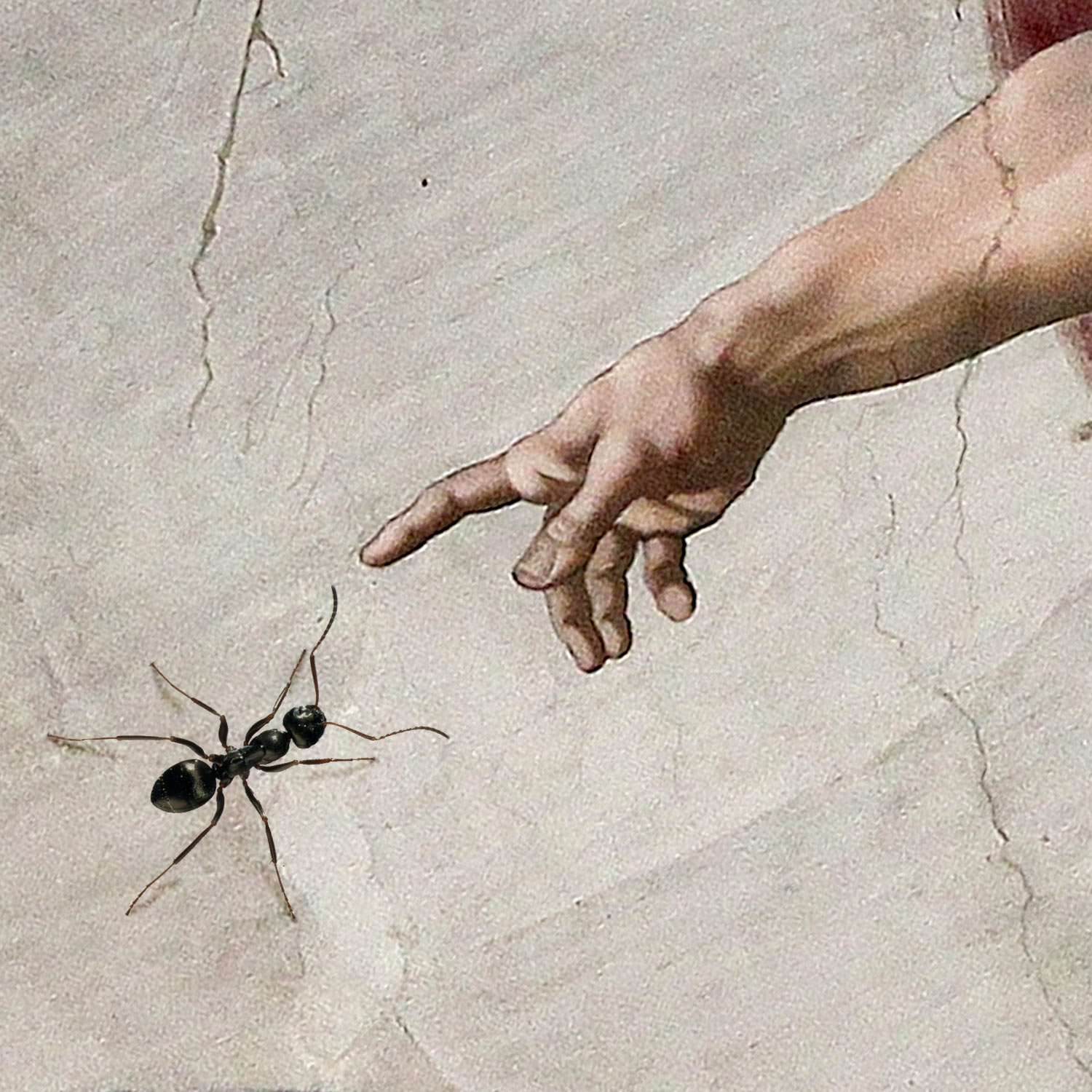
So I've been watching and a couple of days ago, they had built this tunnel and they built a cavern. It's like the size of the size of a quarter but it's it's shaped it shaped more like a triangle with the point upwards. And then the tunnel collapsed. And all the ants had cleared out of there except for one and it got stuck in there. I noticed it and it's you know it just was pacing back and forth and it would try to climb the dirt walls, but they’re overhung in it would fall off and it would try to climb the glass but fall for that too. So the ants are above it are just an inch away but they didn't even know it was there.
I gotta ants because they're no responsibility. Put a little sugar in the top. It's no big deal but now I feel like this great burden of responsibility for this, this trapped ant.
And I thought it died yesterday but it just was sleeping for a long time. And I felt like I could help it too. I could, you know, put a stick down there and poke a hole and let him out. It's you know, that's not out of my control.
But I didn't. I watched this and watch this and pace back and forth and back and forth and then it would sleep and then it would wake up and it was hopeless.
And I had the question: Am I my benevolent god to these ants? Am I passive? Turns out I'm a nonreactive God, I'm passive. I put things in motion and I stand back to watch.
When they die they get brought up to the surface and just laid there. Usually they bring them up in pieces, which is kind of morbid to see an ant carrying another ant head. But not this guy. No one will ever touch him.
I have to let them be and they're going to tunnel. These tunnels collapse—they know that. They're making their own choice to do it—he's moving! I just saw him move. His little leg twitched. I was kind of content, that he was dead and that that was the end of the story. But now he's moving again. And I gotta I gotta I gotta question that all over again.
~~~~~~~~~
Jeff Emtman:
Here Be Monsters podcast about…
Jacob Lemanski:
…you know it was my fault from the beginning…
Jeff Emtman:
…the podcast about the unknown.
~~~~~~~~~
Jacob Lemanski:
My first ant farm was an Uncle Milton’s ant farm, just like the regular toy store and farm. I had set it up and I got ants in the mail. They said like 25 of them put them in there and they were digging and after a few days of that I went out in the yard and I I found more ants. I just I got eggs I picked up the eggs and I put maybe 20 eggs into my ant farm. And for two weeks, they moved those eggs back and forth.
They all started hatching and ants, they they don't get along they'll fight if they're from different colonies. So these these like baby ants started the fight that the ants that were established there, like a war broke out. And I was like probably like eight years old. And I just remember like running home from school, so II could watch his battle unfold in my ant farm. And I remember after like two or three days, just everything was dead. Just like total annihilation. I remember one little one of the larger ants running up the little ant hill was to have the baby and like biting it there like latched on to it. And at the top of the hill it just died.
I wouldn't do that now though. I feel like I'm more compassion for them now. Not so much to rescue this guy. Yeah, I kind of feel I kind of feel like heavy in my heart about it, but I'm just gonna let that and die it's just nature's way.
Uh, he’s like twitching in again, I was just about to say I'm pretty sure he's dead. He's really close to dead, like death throes.
Jacob Lemanski 8:40
There's a there's a day when I was biking in South Africa. I stopped. I stopped at a park for just taking a break for lunch. And the park was just like a leash right on the coast like like the ocean was across from the park but the park was kind of like a little valley went perpendicular away from the from the ocean. It was a little gravel, a little gravel track, maybe a couple 100 yards long. There's some trees around the grass was cut around the road. And then there was just a turnaround at the end. And there was a couple workers cutting grass or something like right at the entrance. And then there's no one else in the park and I went to the back and I sat under a tree in the shade. You know got up my lunch, probably playing guitar.
And as I sat there a car drove up and there's going fast went up to the turn around and stopped. And it was a couple the guy was driving and they were fighting and they got out and we're screaming at each other and they were unit they were getting pretty violent, like slapping like open hand hitting and you know she was hitting back a little bit but mostly he was slapping her and they didn't see me but like I could see them and I watched and I didn't I didn't do anything. And you know she she ran from him and it Yeah, he ran and tackled her. Yeah, he was irate. And she was really angry too. Like she was yelling right back at him
And he had something in his hand. And they were too far away, couldn't see what it was.
And he would raise it like he's going to hit her with it. And she would she would really cower, because, like whatever it was was was really going to hurt but he wouldn't hit her with it. And I didn't know what it was. And you know, I kind of feared for my own safety a little as well. If I went over there.
Yeah, I'm not brave in that way. Eventually he grabbed her by the hair and pulled her to the car and closed her in the passenger seat and he went around to the driver's side and they, you know, sped out of there. The whole thing was, you know, it's probably one minute that they're there fighting. And I don't think I don't think me intervening could have done much at all, you know, for them and their situation, but in the moment you know, maybe could have helped her.
I have a lot of I have a lot of shame that I didn't do anything. I feel sad about it. But also, you know, accept it and it's, it's, you know, it's all right now learn from it. I'm just like this is in my nature, like this is kind of who I am as a person and I'm just pretty well accepting of that. So, like it doesn't bother me. That this is these are my decisions.
[laughs] Well, obviously it does bother me if I'm talking about it like this. Actually, you know, whatever the next time is, like I hope I make the other decision. I don't know. Yeah, I think I got it wrong twice.
Jacob Lemanski 13:35
it's done. That ant is dead. It was my fault from the beginning. I created this little world for him. I collected the ants. I placed them in here.
I set the whole thing in motion and just the way it is. They're all going to die in here. set things in motion and then just watch you know, like, really I'm not passive. I like I gathered all this. I gathered these ants. I put them in this situation. And then I let this one die. And that's like that goes from being passive. To really like, I created the whole situation. And then just let this ant die here just for my own entertainment I guess.
That's why I have these things. Just for entertainment. And I thought I was good. I thought I would be a good God. I did just feed on like pure cane sugar. You know they got to dig their life wasn't bad once I had them.
Except for this one. She’s just she's just dead in that cavern. Maybe it wasn't so good for her. I always thought I was nice to them. I’ll let you know if they uncover her. I’ll see if I can read any of their emotions. It'd be like finding a buried mummy or something like that.
Jeff Emtman 15:37
Jacob Lemanski’s dead ant was never recovered. After it died it sat there in that cavern for several days until the ceiling fell in. Over several weeks, the rest of the colony slowly ceased digging as their population dwindled, because Jacob had never given them their queen. You know, several years ago, Jacob Lemanski told me that he was aspiring in life to become a sophisticate, but when I asked him about this just last week, he told me that sophistication isn't actually that great after all. And nowadays, he just rides his bike and builds ant farms. He has a company, it's called Ant Life. You can find his beautiful handmade wooden ant colonies online at AntLife.space. We also have a link to ant life on our website, which is HBMpodcast.com. There you'll also see a time lapse video of Jacob's ants digging in the dirt. Again, we're HBMpodcast.com My name is Jeff Emtman and I produced this episode. I had help from Bethany Denton. Music came from the black spot. Here Be Monsters as a part of KCRW's independent producer project or editor there is Nick white…
Jacob Lemanski 17:15
…you know, put a stick down there and poke a hole and let him out.
Jeff Emtman 17:23
Thanks for listening, more episodes soon.
Jacob Lemanski 17:44
While I'm on the subject of ants, I'll tell you a story. When I was camping in Central America, there were there were leaf cutter ants around. And I would come across these trails of leaf cutter ants and just 1000s and 1000s of ants and they're carrying little bits of leaves, like the size of fingernails. And they were cool and I would look at him and then I would hang my hammock somewhere and go to sleep and on three occasions. Three times this happened and those leafcutter ants climbed up the tree where I was crawled onto the bug mesh which I kept over my hammock and they would they would cut holes in my hammock and you know, take my take my bug mesh away. And I guess they thought it was leaves that they could eat I'm not sure and then I'd have to get up get my sewing kit and I would sew the bug mesh of my hammock like under the moonlight or under my headlamp. You know sometimes it would be an hour before I could get all these holes so and then I'd go back to sleep and that was just kind of an interesting Central American jungle camping experience.
End